
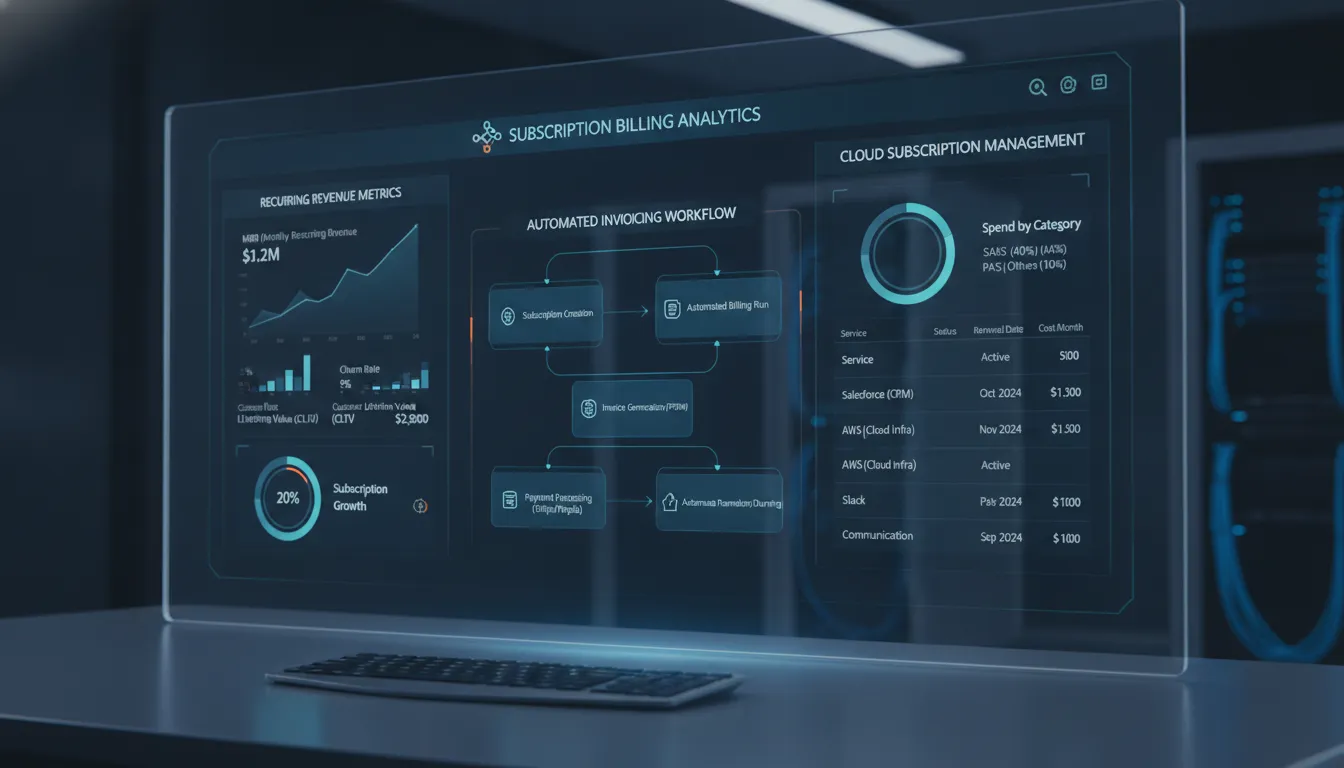
Managing recurring subscriptions manually on spreadsheets creates massive errors and slows down your billing process.
NetSuite SuiteBilling is a unified, cloud-based platform that automates and simplifies recurring subscription billing and management for businesses. Built directly inside the ERP system, it supports evergreen to time-based subscriptions and manages multiple pricing models, such as flat, tiered, or consumption-based rates. By automating lifecycle events like upsells, downsells, and prorated change orders, this module eliminates manual tasks and reduces billing errors. It also integrates seamlessly with core accounting and Advanced Revenue Management to help businesses ensure ASC 606 compliance and gain real-time visibility into metrics like monthly recurring revenue.
Adapting to complex recurring models can challenge even the most experienced finance teams. Understanding NetSuite SuiteBilling for Modern Subscription Businesses is the first step toward streamlining your operations and unlocking predictable growth. Let us explore how this tool manages subscription billing at scale.
Understanding NetSuite SuiteBilling for Modern Subscription Businesses
The global subscription economy continues to grow at a rapid pace. Research shows this market is projected to reach $1.5 trillion by 2033, growing at a compound annual growth rate of 13.3%. For software as a service (SaaS) and subscription-box companies, managing this growth requires robust financial systems. Many businesses face issues with fragmented billing tools, disconnected data silos, and slow manual reconciliation. NetSuite SuiteBilling solves these challenges by connecting core business processes into a single, unified cloud platform.
Solving the Pain of Fragmented Systems
Modern businesses often struggle to manage recurring billing with manual spreadsheets or basic tools. These entry-level systems lead to invoicing errors and high revenue leakage. When sales data sits in one tool and billing in another, accounting teams must spend days checking and matching entries. This friction slows down monthly closing processes. It also prevents finance leaders from getting a clear view of key performance indicators like monthly recurring revenue. Connecting these operations prevents manual mistakes and keeps teams aligned.
Streamlining Complex Billing Lifecycles
Subscription businesses need tools that handle diverse billing structures and customer changes over time. Software firms often utilize multiple models, including flat-rate, tiered, or consumption-based structures. NetSuite SuiteBilling manages this complete lifecycle from a single portal. It supports various subscription schemes, ranging from evergreen plans to traditional time-based terms, such as one-year or three-year agreements. The system easily handles mid-term changes, such as when a customer decides to upsell, downsell, suspend, or terminate their account, by prorating the charges automatically.
Automating Invoices for Operational Efficiency
Consistent, accurate invoicing is vital for maintaining customer trust and preserving steady cash flow. The module features a powerful rating engine and automated scheduling for consistent invoicing with fewer errors. Instead of requiring accounting teams to generate bills by hand, the platform schedules and runs invoicing runs on a set basis. This automation reduces invoice cycle times, allowing teams to focus on strategic growth. For a comprehensive look at how these financial tools fit into the wider ERP ecosystem, you can read our NetSuite SuiteBilling modules resource. Partnering with certified experts for NetSuite SuiteBilling implementation ensures your billing runs smoothly from day one.
Key Features That Drive Billing Efficiency
Managing recurring revenue requires billing tools built for scale. Standalone spreadsheets cannot sustain this work as your business grows. NetSuite SuiteBilling automates the billing process. It connects core business systems to remove manual effort. It also keeps your data clean across subscription terms.
Flexible Pricing Models for Diverse Markets
Modern businesses must adapt their pricing models to stay competitive. SuiteBilling provides support for multiple billing options. This includes flat, tiered, and consumption-based rates. It lets companies combine flat-rate plans with tiered pricing or usage charges. This mix makes it easy to match customer usage patterns exactly.
The billing engine handles complex rating scenarios with ease. It manages volume discounts and customer-specific rates without manual math. This flexibility allows SaaS and mid-market firms to run custom promotions. At the same time, it ensures that every invoice stays completely accurate.
End-to-End Subscription Lifecycle Management
Managing a subscription is more than just sending a monthly bill. The customer journey involves constant plan changes. SuiteBilling manages the entire subscription lifecycle from start to finish. It handles ongoing adjustments like plan upgrades, downsells, suspensions, and terminations.
When plans change mid-month, calculating partial costs can create work. The system solves this by automating proration and plan updates. It also aggregates different fees onto a single customer invoice. This keeps your billing clean and saves hours of back-office work.
Automated Renewals and Revenue Protection
Manual contract renewals often lead to missed revenue. SuiteBilling prevents this by automating the renewal process. The system automatically creates renewal invoices to improve retention rates. It also stops revenue leakage caused by forgotten contract terms or late billing cycles.
The platform also protects your margins against rising costs. You can set percentage-based price increases to apply automatically upon renewal. These price uplifts can be configured at the line-item level. They can be set during subscription creation or when a contract is renewed. It gives finance teams full control over customer pricing.
High-Volume Tracking and Invoicing
For SaaS firms, tracking real-time usage data is a big challenge. SuiteBilling is designed to handle high-volume usage statistics with ease. It matches customer usage data against dynamic contract terms and pricing rules. This process runs automatically to keep billing accurate.
Billing automation cuts invoicing times from days to hours. Businesses can connect their external systems for automating recurring billing workflows. This integration keeps data moving between platforms. It also makes sure your billing reflects real customer usage.
Integrating SuiteBilling with Advanced Revenue Management
Managing high-growth subscription models requires a tight connection between billing actions and revenue recognition. When you use NetSuite SuiteBilling to run your subscription operations, pairing it with NetSuite Advanced Revenue Management (ARM) creates a single, unified financial system. This integration allows your business to automate complex accounting tasks, reduce compliance risks, and gain real-time visibility into your subscription performance.
How SuiteBilling and ARM Work Together
Modern subscription agreements often involve multiple changes over time, such as upsells, downsells, and suspensions. By bringing billing and revenue management together, you can ensure that every change to a customer contract automatically flows into your general ledger. This unified approach eliminates the need to manually pass data between separate billing software and accounting spreadsheets.
Under this integrated model, billing actions are fully decoupled from revenue recognition. An invoice generated by your billing engine does not dictate when you recognize the revenue. Instead, billing events occur on their own schedules, while the revenue engine schedules recognition based on actual service delivery or contract terms. This separation is vital for companies that offer complex usage-based pricing or hybrid subscription terms.
Ensuring ASC 606 and IFRS 15 Compliance
Meeting the strict demands of ASC 606 and IFRS 15 revenue standards is a major challenge for growing software and technology firms. The integration between these two NetSuite tools automates compliance by creating formal revenue arrangements directly from subscription records. When a customer signs a contract or initiates a change order, the system instantly sets up a revenue arrangement to track performance obligations.
The revenue engine then allocates the transaction price across those obligations based on standalone selling prices. As services are delivered, the system automatically generates the correct revenue recognition journal entries. This systematic automation protects your business from compliance audit risks and ensures your financial statements are accurate and reliable.
Tracking Real-Time Revenue Metrics
A major benefit of linking your billing and revenue engines is the ability to track key subscription metrics in real time. Instead of waiting for the end of the month. Your leadership team can access up-to-date metrics like Monthly Recurring Revenue (MRR) and Annual Recurring Revenue (ARR) through integrated dashboards. These live analytics help you make fast, data-driven decisions about pricing, product packaging, and sales strategies.
Because the metrics are pulled directly from live transactional data, you can trust their accuracy. You can view ARR and MRR trends by customer segment, product line, or contract type. This deep level of financial visibility is essential for managing cash flow and proving your business value to investors or board members.
Expert Implementation with Streams Solutions
Setting up a unified subscription and revenue engine requires a deep understanding of both system logic and accounting rules. Working with certified Advanced Revenue Management integration consultants ensures your system is built to match your specific business model. At Streams Solutions, our experienced team helps mid-market businesses configure NetSuite to handle complex pricing and compliance needs.
Our consultants use our structured StreamsWay methodology to guide you through every step of the implementation process. We analyze your contract structures, map your revenue recognition rules, and build automated workflows that fit your financial goals. With our certified expertise, you can confidently automate your recurring billing and revenue recognition to build a scalable foundation for business growth.
Automating the Subscription Lifecycle
Managing recurring revenue demands absolute precision at every stage. Using NetSuite SuiteBilling allows modern businesses to automate each phase of the subscriber journey. This cloud-native solution replaces manual tracking with a unified workflow, helping to prevent costly errors and improve customer retention. By integrating subscription data directly into your core financials, you can build a stable foundation for scalable business growth.
From Sales Order to Bill
Manual data entry often causes errors in recurring billing. NetSuite SuiteBilling solves this by turning sales orders and quotes directly into active subscriptions. Once a sales rep closes a deal, the platform reads the terms and maps them to the billing engine. This automated step links physical sales, digital access, and recurring schedules under a single source of truth.
Managing Lifecycle Milestones
The lifecycle of a subscriber is rarely a straight line. Businesses must adapt to changes, renewals, and cancellations on the fly to keep operations running smoothly. The standard process follows five key steps:
- Subscription Creation: The journey begins when the system automatically sets up an evergreen or term-based account from an approved sales order. This eliminates the need to re-key customer billing details.
- Automated Billing Runs: A powerful rating engine calculates charges based on flat, tiered, or consumption-based pricing rules. For SaaS firms, this allows for the accurate tracking of high-volume usage statistics against dynamic terms.
- Mid-Cycle Modifications: Customers often need to alter their plans. The system supports flexible change order management to handle upsells, downsells, suspensions, and terminations. Any mid-cycle changes automatically calculate prorated billing charges on the next invoice.
- Automated Renewals: To protect recurring revenue streams, the platform auto-generates renewal invoices prior to expiration. This process improves retention and reduces revenue leakage by removing manual renewal tasks.
- Renewal Price Uplifts: You can apply a percentage price increase automatically to a customer’s renewal pricing. These uplifts can be set at subscription creation or at renewal, with the flexibility to calculate the increase at a line-item level.
Customizing Your Automation
Every subscription business has unique rules for usage tracking and billing terms. While NetSuite SuiteBilling offers deep native features, some workflows require tailored logic. The certified NetSuite consultants at Streams Solutions use their deep SuiteScript and SuiteFlow expertise to build custom automation scripts. These custom scripts can connect third-party platforms to NetSuite to ensure your recurring billing runs smoothly at any scale.
Best Practices for SuiteBilling Implementation
A successful NetSuite SuiteBilling implementation requires deep planning and a structured path. Businesses must focus on data readiness and system design to get the best return from their software. Following these steps helps teams avoid common errors and build a billing system that can scale as the business grows.
Focus on Data Readiness and Pricing Rules
Clean data is the foundation of any billing system. Before you begin, audit all active customer contracts, current pricing models, and billing histories to clear out old or bad records. Your team must map how NetSuite SuiteBilling will track high-volume usage statistics against dynamic subscription terms. Setting clear rules for flat-rate, tiered, or consumption-based models early prevents errors during go-live. This work ensures your pricing records match your sales contracts from day one.
Test System Workflows in Sandbox
Never rush your billing setup straight to your live account. Use a NetSuite sandbox to run full billing cycles and check for accuracy. Work with your IT team to test complex subscription actions. These include upsells, downsells, mid-cycle changes, and cancellations. Sandbox testing lets you verify that the automated rating engine calculates prorated charges correctly. It also ensures that automated scheduling for consistent invoicing creates clean documents without manual touchpoints.
Use Expert Accelerators and Methodology
Setting up billing software is a big shift for your finance and sales teams. Streams Solutions uses the StreamsWay methodology to guide this change. This approach focuses on trust, collaboration, and client value to keep your teams aligned. Our team uses custom SuiteScript, SuiteTalk, and SuiteFlow tools to connect your billing workflows to your ERP. Streams Solutions has pre-built accelerators that can reduce implementation time by 40% to 60%. These tools speed up your timeline so you can go live and realize value faster.
Comparing SuiteBilling with Alternative Billing Solutions
Selecting the right subscription billing system is a key decision for growing businesses. Standing at the center of your cash flow, your billing platform must handle complex transactions without adding manual work. For companies that already run on NetSuite ERP, the choice often comes down to NetSuite SuiteBilling implementation versus integrating a standalone subscription management system.
Standalone Billing Tools and Enterprise Realities
Many startup firms start with standalone billing tools. These platforms offer fast setup and clean user interfaces for basic subscription needs. If you do not require a deep ERP connection, standalone tools can work well. But as your business grows, keeping your billing software separate from your main financial ledger can cause major operational drag. Finance teams often have to spend hours or days manually moving invoice data and reconciling accounts.
When billing data lives outside your ERP system, you must build custom middleware to sync your records. Over time, these custom integrations can break. This leads to manual spreadsheets, double data entry, and a higher risk of audit failures. This is why mid-market firms looking to scale often choose to automate recurring subscription billing entirely inside their primary ERP database.
Comparison of Key Billing Solutions
To help you choose the best path, the table below compares NetSuite SuiteBilling with other top market platforms. It evaluates them across five critical dimensions for mid-market business operations.
| Dimension | NetSuite SuiteBilling | Chargebee | Zuora | Maxio | Recurly |
|---|---|---|---|---|---|
| ERP Integration | 100% Native (no sync needed) | Requires middleware or sync tools | Requires complex custom sync | Requires third-party connectors | Requires connector sync |
| ASC 606 Compliance | Native with ARM integration | Limited native accounting engine | Has native revenue engine | Has native revenue engine | Requires separate software |
| Pricing Models | Flat, tiered, consumption models | Flat and standard tier options | Complex custom tier schedules | SaaS-focused tiered pricing | Flat and simple tiers |
| Complex Scale | Built for enterprise workloads | Best for simple subscription paths | Scales to high custom complexity | Best for mid-market SaaS needs | Best for retail B2C subscriptions |
| Cost of Ownership | Low overhead if already on NetSuite | Low setup cost but extra sync fees | High setup and high support fees | Medium setup and medium support fees | Low setup but rising transaction fees |
The ERP Native Advantage
The primary advantage of NetSuite SuiteBilling is its native design. Because it lives directly within the NetSuite ERP ecosystem, there is no need for third-party middleware, custom APIs, or manual synchronization. Every transaction, subscription renewal, and pricing change updates your general ledger in real time. This native connection makes sure your financial reporting remains completely accurate.
For SaaS firms handling high-volume usage, standalone systems often struggles to link consumption data to revenue recognition schedules. Choosing an ERP-native tool solves this issue. It lets you automate NetSuite SuiteBilling modules alongside Advanced Revenue Management. By bringing billing and revenue recognition into a single system, you can easily comply with strict accounting standards like ASC 606 without extra spreadsheets.
Frequently Asked Questions
What is NetSuite SuiteBilling?
NetSuite SuiteBilling is an add-on module built directly on the core cloud ERP platform. It simplifies and automates the billing and management of recurring subscriptions. According to NetSuite, the software automates scheduling, tracks complex rates, and handles the full subscription lifecycle from start to renewal.
How does NetSuite SuiteBilling support multiple pricing models?
The module provides a robust rating engine that accommodates flat rates, tiered rates, and usage-based plans. You can mix these billing options with custom rates and promotions for maximum pricing flexibility. This allows SaaS and subscription-box companies to calculate accurate invoices for complex usage details without the need for manual spreadsheets.
Can NetSuite SuiteBilling help with ASC 606 revenue recognition?
Yes. NetSuite SuiteBilling integrates directly with NetSuite Advanced Revenue Management to help companies comply with ASC 606 and IFRS 15 standards. Merging your billing schedules with automated revenue management ensures that revenue is recognized accurately as services are delivered. It also provides real-time visibility into metrics like monthly recurring revenue.
How does NetSuite SuiteBilling prevent revenue leakage during renewals?
The software reduces revenue leakage by automatically generating renewal invoices and applying scheduled price increases at the line-item level. Since the process is automated, subscription modifications, proration, and renewals happen without manual delay. This seamless system ensures consistent cash flow and helps businesses retain more customers over time.
Ready to simplify your subscription billing?
Manual billing processes and complex spreadsheets will slow your business growth. Relying on outdated methods leads to billing errors, delayed invoices, and unhappy customers. If you wait to automate your billing operations, you risk falling behind competitors who use modern automation. Setting up a streamlined billing system now will secure your revenue, prevent billing leaks, and help you scale your operations with ease. Every day you delay is another day spent on manual work that you could automate.
Ready to automate your billing operations? Schedule a free consultation with Streams Solutions to discuss your NetSuite SuiteBilling implementation. Our certified experts will guide you through every step of your billing setup so you can run your business with complete confidence.