

The NetSuite vs Dynamics 365 decision is not simply a feature comparison. It is a choice about the operating model, governance structure, and technology ecosystem that will support the next stage of growth. NetSuite often fits organizations seeking a unified cloud ERP foundation. Dynamics 365 often fits organizations that value modular applications and close alignment with Microsoft technologies. The right answer depends on financial complexity, operational requirements, integration strategy, and the internal capacity to govern change.
Schedule a free ERP consultation to evaluate NetSuite and Dynamics 365 against your growth roadmap.
Executive answer: Choose NetSuite when standardization, a unified data model, and multi-entity visibility are central priorities. Give Dynamics 365 stronger consideration when modular deployment, Microsoft ecosystem continuity, and flexible application architecture are strategic priorities. Do not select either platform until finance, operations, and IT agree on measurable outcomes and the future-state operating model.
NetSuite vs Dynamics 365 at a glance
Both platforms can support core financial management, operational control, reporting, automation, and integrations. Their fundamental approaches differ, which affects implementation scope and long-term governance.
| Decision area | NetSuite | Dynamics 365 |
|---|---|---|
| Architecture | Unified cloud ERP suite | Modular family of business applications |
| Common strategic fit | Organizations prioritizing standardized processes and shared financial and operational data | Organizations prioritizing modularity and Microsoft ecosystem alignment |
| Governance emphasis | Configuration discipline and enterprise-wide process standardization | Application architecture, environment governance, and integration discipline |
| Evaluation focus | Entity structure, financial controls, operational modules, and suite-wide reporting | Required applications, deployment sequence, Microsoft capabilities, and target architecture |
NetSuite: a unified cloud ERP foundation
NetSuite is designed around a shared suite for finance and related operational processes. For organizations moving away from disconnected accounting, inventory, order management, or reporting tools, this structure can create a clearer path toward standardized controls and consolidated visibility.
A unified suite does not eliminate design decisions. Finance leaders still need to define the chart of accounts, reporting dimensions, approval policies, entity structure, and close process. IT leaders must govern data migration, identity, integrations, extensions, and release readiness. The Streams Solutions Oracle NetSuite guide provides more context on the platform and its business applications.
Dynamics 365: modular business applications
Dynamics 365 is a family of applications rather than a single configuration. A growing company may evaluate Dynamics 365 Business Central, while an organization with more complex finance or supply chain requirements may consider a different combination of Dynamics applications. This makes precise scope definition essential.
Dynamics 365 can be compelling when Microsoft 365, Azure, Power BI, or Power Platform already play a strategic role. That ecosystem alignment may improve adoption and extend analytics or automation capabilities. It also creates a responsibility to govern applications, integrations, environments, and extensions as a coherent enterprise architecture. Review the Streams Solutions Microsoft Dynamics 365 services for additional platform context.
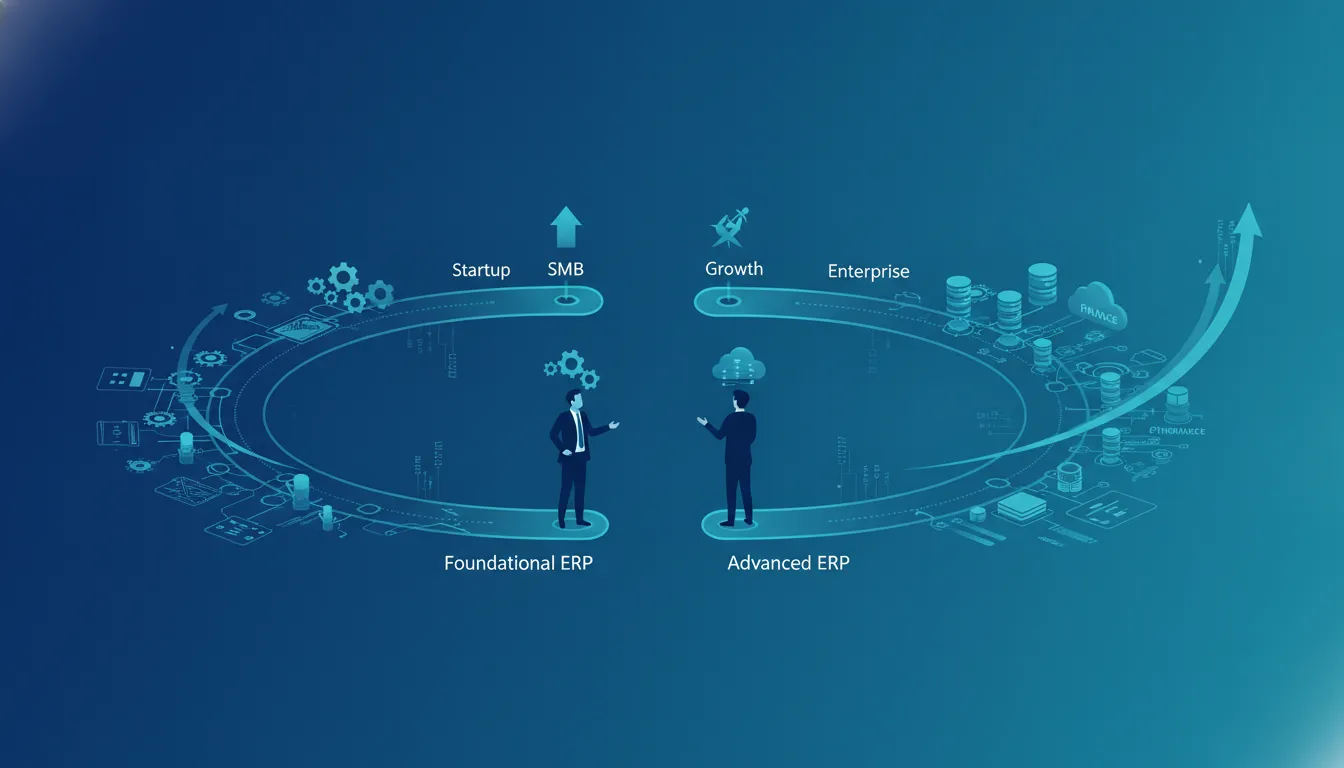
Which ERP fits each growth stage?
Growth stage is more useful than employee count alone. Two companies of similar size can have very different ERP requirements when one operates a single domestic entity and the other manages multiple entities, acquisitions, inventory, or complex revenue processes. Leadership should evaluate the stage the organization expects to reach during the useful life of the ERP.
Early scale: establish governed processes
At early scale, the objective is usually to replace spreadsheets and disconnected applications with reliable financial and operational processes. NetSuite may be a strong candidate when leaders want a shared ERP foundation from the outset and anticipate additional entities, channels, or inventory complexity.
Dynamics 365 Business Central may deserve greater weight when the organization already relies on Microsoft tools, has access to Microsoft-oriented expertise, and wants a familiar application environment. At this stage, the most important discipline is controlling scope. Excessive customization can overwhelm limited internal capacity regardless of platform.
Mid-market expansion: coordinate functions and entities
During mid-market expansion, ERP requirements shift from basic transaction processing to cross-functional coordination. Leadership may need consolidated reporting, formal procurement controls, scalable order management, stronger forecasting inputs, and dependable connections with CRM, ecommerce, payroll, or planning applications.
NetSuite’s unified structure can support a consistent operating model across business units. Dynamics 365 can support a modular architecture tailored to differentiated requirements. The decision turns on whether the company benefits more from standardization or from modular flexibility, and whether it has the governance capacity to sustain that choice.
Complex scale: govern specialized requirements
At complex scale, neither platform should be evaluated through a generic demonstration. The selection team needs scenario-based validation for consolidation, intercompany activity, supply chain processes, controls, reporting, integrations, and security. The team should also model acquisitions, new business models, and future geographic expansion.
The preferred ERP is the one that satisfies critical scenarios with an acceptable level of configuration, extension, and operational support. A platform with more apparent flexibility can become expensive if every business unit follows a different process. A more standardized platform can become restrictive if essential differentiation is forced outside the ERP.
Evaluate finance and operational complexity
CFOs and IT directors should convert broad requirements into testable business scenarios. A useful evaluation does not ask whether a platform has a feature. It asks how the platform supports the organization’s specific process, control, data, and reporting requirements.
Finance requirements to test
- Entity structure, consolidation, intercompany activity, and eliminations
- Revenue management, billing, expense allocation, and close processes
- Budgeting, planning, forecasting inputs, and management reporting
- Audit trails, segregation of duties, approvals, and regulatory controls
- Changes expected from acquisitions, geographic expansion, or new revenue models
Finance leaders should define the decisions they want better data to support. That creates a more useful evaluation than a long checklist of loosely prioritized capabilities. It also helps the implementation team distinguish business-critical requirements from preferences.
Operational requirements to test
- Order-to-cash and procure-to-pay workflows
- Inventory visibility, fulfillment, purchasing, and demand planning
- Project, service, subscription, or manufacturing processes where relevant
- CRM, ecommerce, payroll, banking, and analytics connections
- Exception management, approvals, and role-based responsibilities
Executives should validate cross-functional processes from beginning to end. A finance demonstration may look strong while concealing operational handoffs that depend on manual work or fragile integrations. The evaluation should expose those handoffs before a contract and implementation plan are finalized.
How should leaders compare implementation risk?
ERP risk is driven less by the product name than by scope, data quality, process decisions, integrations, executive sponsorship, and organizational readiness. Strong governance can make either platform manageable. Weak governance can undermine either platform.
Define scope and decision rights
Begin with a concise set of measurable outcomes, such as reducing close-cycle friction, improving entity-level visibility, strengthening procurement controls, or creating a governed integration architecture. Assign decision owners for finance, operations, data, security, and change management. Without clear decision rights, unresolved design questions become delays or costly rework.
Prepare data, processes, and people
Data migration is a business workstream, not merely a technical task. The organization needs ownership for cleansing, mapping, retention, validation, and reconciliation. Process owners also need time to define future-state workflows and approve changes. Training should prepare each role to operate the new process, not only navigate screens.
Request an ERP readiness assessment to clarify requirements, implementation risk, and the best deployment sequence for your organization.
Model total cost and operating capacity
A credible business case includes licensing, implementation, migration, integrations, extensions, training, internal staffing, support, and future enhancements. Compare costs across a multi-year period and document the assumptions behind each estimate. The model should also account for the internal capacity needed to govern the platform after launch.
How do integration and technology strategy affect the choice?
Integration architecture can determine whether an ERP remains adaptable or becomes a constraint. Inventory systems, ecommerce, CRM, payroll, banking, analytics, and specialized applications may all exchange critical data with the ERP. The selection team should assess those connections as part of the platform decision.
Assess ecosystem advantage without creating lock-in
Dynamics 365 may offer a natural advantage for organizations with substantial Microsoft expertise and investment. NetSuite’s suite model may reduce the number of connections required among core business functions. Neither advantage removes the need to identify systems of record, data ownership, integration patterns, monitoring, and recovery processes.
Review Streams Solutions’ ERP integration guidance for procure-to-pay to see how integration design affects a cross-functional business process.
Govern extensions and automation
Customization should be treated as an investment with an owner, business case, test plan, and support model. Configuration is generally easier to govern than custom code, but even configuration can create complexity when applied inconsistently. Before approving an extension, ask whether it supports a differentiating process or merely preserves an outdated practice.
Automation requires similar discipline. A workflow can improve control and cycle time, but poorly governed automation can make errors move faster. Define exception handling, monitoring, ownership, and audit requirements before automating a process.
A decision matrix for CFOs and IT directors
A weighted decision matrix creates a transparent comparison and exposes disagreements early. Finance, operations, and IT should score each platform independently, then discuss major differences and validate them through focused demonstrations or discovery sessions.
Recommended evaluation criteria
- Business outcomes: Which platform best supports the measurable improvements leadership expects?
- Process fit: How well does each platform support critical end-to-end scenarios?
- Financial complexity: Can it govern entities, reporting, controls, and evolving revenue models?
- Architecture: Does it align with systems of record, integration standards, data strategy, and security?
- Implementation risk: What scope, migration, adoption, and governance risks must be managed?
- Total cost: What are the multi-year licensing, implementation, support, and change costs?
- Adaptability: Can the operating model evolve without uncontrolled customization?
Make the recommendation conditional
A defensible recommendation states why a platform fits and the conditions required for success. For example, NetSuite may be preferred if the company adopts standardized processes across entities. Dynamics 365 may be preferred if the organization commits to an application architecture and has the capabilities to govern it. Conditional recommendations are more useful than absolute claims because they connect platform fit to management decisions.
Questions to ask before choosing NetSuite or Dynamics 365
- Which business outcomes must improve within the first year?
- Which processes should be standardized, and which genuinely differentiate the business?
- What financial, entity, reporting, and control complexity must the ERP support?
- Which applications will remain, and how will they connect to the ERP?
- Who owns process decisions, data quality, security, and change management?
- What internal capabilities are available after implementation?
- What future scenarios could materially change requirements?
Answers to these questions narrow the field and improve implementation planning. They also help leadership avoid selecting a platform based on a polished demonstration that does not reflect the realities of the business.
Frequently asked questions about NetSuite vs Dynamics 365
Is NetSuite or Dynamics 365 better for a growing company?
The better ERP is the one aligned with the company’s operating model, growth plans, internal capabilities, and technology strategy. NetSuite often suits organizations seeking a unified cloud ERP. Dynamics 365 can suit organizations that value modularity and deep Microsoft ecosystem alignment.
Which platform is easier to implement?
Implementation difficulty depends more on scope, data quality, process design, integrations, and governance than on the platform name. A disciplined discovery process and phased roadmap reduce risk for either ERP.
How should CFOs compare total cost?
CFOs should compare a multi-year cost model that includes licensing, implementation, data migration, integrations, extensions, internal staffing, training, support, and future change requests. Assumptions should be documented so leadership can compare scenarios consistently.
Can NetSuite and Dynamics 365 integrate with existing applications?
Both platforms can connect with existing business applications. The important question is whether each integration has a clear owner, support model, monitoring approach, and role in the target architecture.
Choose an ERP that supports the next growth stage
NetSuite and Dynamics 365 are both credible enterprise platforms. The stronger choice is the one that aligns with the company’s future-state processes, governance capabilities, financial complexity, and technology strategy. Streams Solutions brings experience across NetSuite, Dynamics 365, integration, analytics, and custom development, helping leadership teams evaluate fit without forcing every organization into one platform.
Schedule a free consultation with Streams Solutions to build an ERP decision framework and implementation roadmap grounded in your business objectives.