

Nonprofits often outgrow entry-level accounting tools once annual revenue exceeds five million dollars. Manual data entry and siloed spreadsheets create errors that threaten donor trust and audit readiness. Migrating to a unified system is the only way to maintain strict financial control.
Schedule a free NetSuite consultation today to see how fund accounting can transform your nonprofit financial operations.
NetSuite nonprofit fund accounting is a unified platform that helps organizations track revenue and expenses across complex grants, programs, and restricted funds. By using custom dimensions like class and department, the system provides real-time visibility into unrestricted, temporarily restricted, and permanently restricted balances. This level of detail is critical for maintaining GAAP and FASB compliance while ensuring that donor funds are used according to specific mandates. According to Streams Solutions, this unified approach prevents the errors and delays common in split systems where fundraising and accounting data live in separate silos. The platform also automates cost allocation and grant reporting, which allows nonprofit leaders to find potential shortfalls before they become major issues. This visibility builds donor trust and ensures that the organization remains ready for its next annual audit or Form 990 filing.
Modern nonprofits must navigate a maze of donor expectations and strict government rules that test the limits of basic accounting tools. The path to building a more resilient organization starts with understanding the growing complexity of nonprofit financial management and why outdated tools can no longer keep pace.
The Growing Complexity of Nonprofit Financial Management
Growing nonprofits face three interconnected financial challenges: manual tools that fail above $5M in revenue. Disconnected systems that hide the true picture of fund health, and strict compliance requirements that demand complete audit trails. NetSuite eliminates all three by unifying grant tracking, donor reporting, and compliance controls in one platform designed specifically for fund accounting.
As a nonprofit grows, its money needs change. What worked for a small group with one grant often fails when the budget hits $5M or more. At this size, manual tools and simple sheets can no longer keep up with the hard work. Leaders face new risks that demand a unified system to help your team stay ahead of these tough changes.
Risks of manual accounting
Many groups start with small tools like QuickBooks or Aplos. These tools work well at first but struggle as the budget grows. Once annual revenue passes $5M, basic accounting software often fails to handle multi-fund needs. A nonprofit must track every dollar to show it is used for the right goal.
Relying on manual data entry makes it easy to make small errors that lead to big problems. These gaps can hurt donor trust and make audits a heavy burden for your team. Without a clear trail, you may find it hard to prove your group is following all rules. Buying a platform that follows NetSuite nonprofit fund accounting best practices can fix these issues before they stall your growth.
Siloed systems and internal controls
Silos are a major risk for mid-market nonprofits. Often, donor data lives in one app while grant data stays in a sheet. This gap between tools leads to poor internal controls and a lack of clear view. It is hard to see the full picture when your systems do not talk to each other. This lack of a shared view can hide errors or even lead to fraud. Without a unified ledger, your staff may spend hours fixing data instead of serving the community.
A connected system ensures your finance data stays clean and safe across every program you run. It links your donor gifts to your program costs in real time. This helps your board see that you are using funds as promised. Streams Solutions has over 10 years of work as a Technical Alliance Partner to help you build these links. We focus on practical outcomes to help your group scale with confidence.
The burden of strict compliance
Meeting rules for grant reporting and tax files takes a lot of time and effort. Nonprofits must track how they use their money based on donor rules. Groups often manage three main fund types to stay in good standing with the law:
- Unrestricted funds that can be used for any part of the mission.
- Temporarily restricted funds that have time or goal limits.
- Permanently restricted funds that must be kept for the long term.
This need for proof makes Form 990 compliance a key driver for groups moving to better software. Clean tax filing with the Internal Revenue Service requires a strong system that tracks every dollar from the start. Using NetSuite for nonprofit organizations gives you the tools needed to meet these exact rules.
What NetSuite Nonprofit Fund Accounting Delivers
NetSuite replaces fragmented entry-level tools with a unified fund accounting platform that tracks unrestricted, temporarily restricted, and permanently restricted funds in real time. Automated cost allocation, FASB-compliant reporting, and the Nonprofit SuiteSuccess edition combine to give finance teams one source of truth for every dollar.
Nonprofit organizations face increasing pressure to prove that every dollar aligns with donor intent and program goals. NetSuite nonprofit fund accounting replaces fragmented entry-level tools with a unified platform designed for the complex tracking requirements of growing nonprofits. Whether your organization manages government grants, private foundation awards, or individual donor restrictions, NetSuite brings all financial data into one auditable system of record.
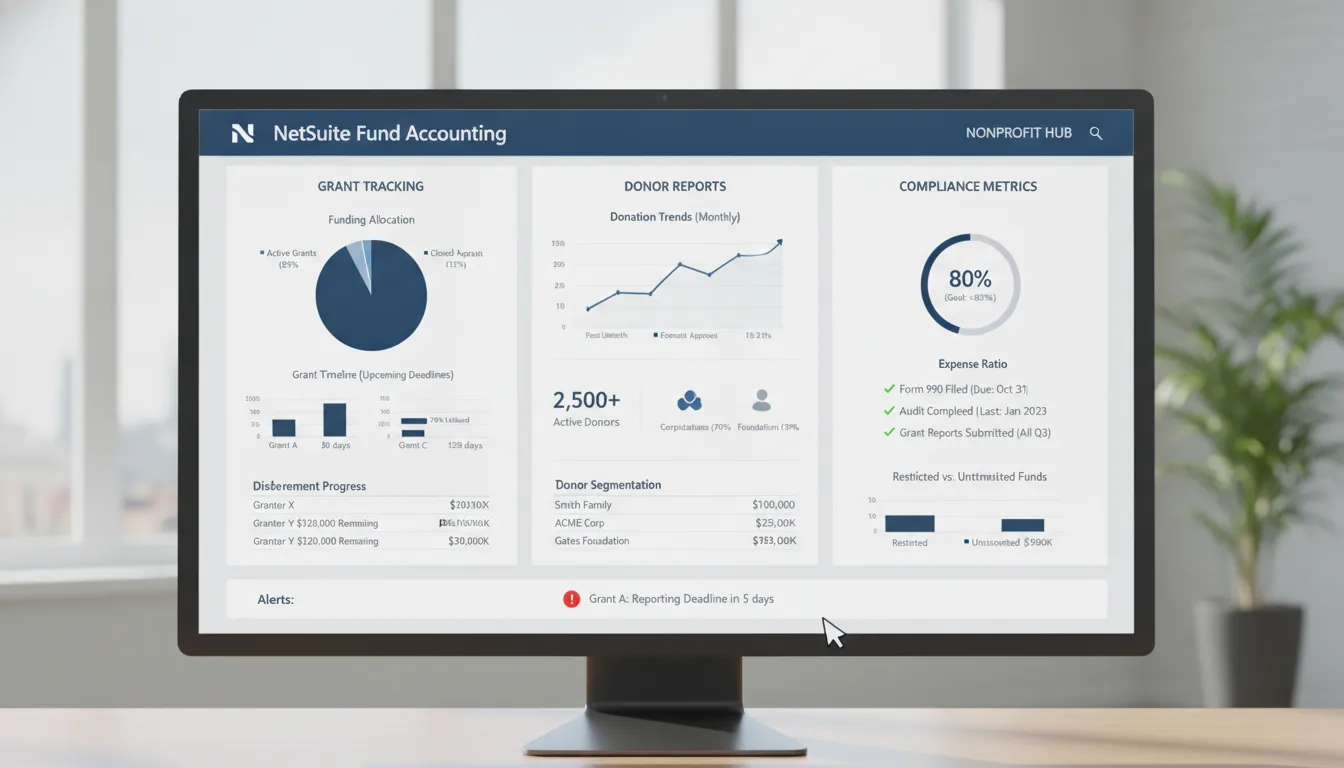
Core fund tracking and dimensions
NetSuite implements fund accounting through its flexible dimension framework. Custom segments, classes, and departments act as labels that tag every transaction to its specific fund, grant, or program. This structure allows your finance team to track three distinct fund categories simultaneously:
- Unrestricted funds that support general operations and mission priorities.
- Temporarily restricted funds limited by donor-defined time frames or program purposes.
- Permanently restricted funds where the principal must be preserved in perpetuity.
The platform automatically releases funds from restriction when spending conditions are met. This eliminates the manual journal entries that often introduce errors in month-end close. Inter-fund transfers are supported with proper elimination entries, giving your auditors a clean trail of every dollar movement between programs.
Cost allocation and compliance controls
One of the most powerful features of NetSuite for nonprofits is automated cost allocation. Shared expenses like rent, utilities, and administrative salaries can be distributed across programs using percentage-based, hourly, or fixed-cost rules customized for each fund. For example, a $1,000 monthly rent bill can be split proportionally across six programs operating from the same office, with different funding sources governing each program’s share.
The system is built to meet GAAP and FASB standards that govern nonprofit financial reporting, including FASB 116 (contributions), FASB 117 (financial statements), and FASB 124 (investments). Real-time fund balance reports give leaders beginning balance, additions, releases, and ending balance for every fund at a glance. This visibility helps your team identify shortfalls or surpluses before they become budget problems.
Nonprofit SuiteSuccess edition and Social Impact Program
NetSuite’s Nonprofit SuiteSuccess edition comes pre-configured with the charts of accounts, roles, and dashboards most nonprofits need to get started quickly. For qualifying organizations, the NetSuite Social Impact Program donates software licenses, significantly reducing the cost barrier for mid-market nonprofits. This edition, combined with the platform’s unified architecture, makes NetSuite a practical choice for organizations that need more than standalone fund accounting software.
Why Are Nonprofits Migrating to NetSuite Fund Accounting?
Nonprofits migrate to NetSuite fund accounting because manual tools and disconnected systems create audit risks, compliance burdens, and operational friction above $5M in revenue. NetSuite solves these problems with real-time fund tracking, automated cost allocation, and FASB-compliant reporting all in one platform.
Many groups outgrow simple tools when they reach about $5 million in yearly income. Manual data entry often leads to mistakes. A shift to NetSuite for nonprofit organizations helps leaders move from broken systems to one platform. This change gives them more control over their mission. It also builds trust with donors who want to see where their money goes.
Solving operational complexity
NetSuite stands out when a group does more than just track grants. It is the best choice for groups that run field work, shops, or complex shipping. While tools like Sage Intacct focus mainly on finance, NetSuite handles both programs and money. It offers a clear view of the whole group. This helps unions and foundations stay on track as they grow. They no longer have to deal with split data that slows down work.
Using one system for everything cuts errors. When fundraising data and grant logs live in different places, it is hard to get a full picture. Split systems often lead to weak internal controls. NetSuite fixes this by putting all data in one safe place. This setup makes it easier for teams to work together and stay ready for audits.
| Feature | Legacy Systems | NetSuite Fund Accounting |
|---|---|---|
| Grant Tracking | Manual logs and sheets | Real-time tracking by fund |
| Scope | Finance only | Programmatic and finance |
| Compliance | Slow manual checks | Built-in FASB and GAAP |
| Growth | Fails at $5M revenue | Built to scale globally |
| Software Cost | Full price | Free social impact licenses |
Better grant and donor reporting
Tracking restricted funds is a top goal for leaders. NetSuite tracks the three main types: unrestricted, temporarily restricted, and permanently restricted. It releases funds from these tags as conditions are met. This makes simplified grant management for non-profits much easier. It removes the need for complex sheets to track each grant dollar.
Leaders can also spot fund gaps or extra cash in real time. This keeps them from overspending on specific programs. It also helps them meet IRS reporting rules to keep donor trust. Automated reports like the Statement of Activities are ready in seconds. This saves time during tax season and helps with Form 990 filings.
Strategic growth and cost savings
The NetSuite Social Impact Program is a huge plus. It gives free software to many qualifying social groups. This makes the move very cheap for mid-sized groups. By using the Nonprofit SuiteSuccess edition, groups get a pre-set system. This means they can start using the tools faster without a long wait for setup.
Groups also use NetSuite to set up custom cost tracking rules. These can be based on hours, fixed costs, or percentages. This helps them spread costs across different programs fairly. Streams Solutions uses proprietary accelerators to speed up these setups. Our team has more than ten years of experience helping charitable groups. We focus on getting the system right so you can focus on your mission.
How Streams Solutions Accelerates Nonprofit NetSuite Adoption
Streams Solutions guides nonprofits through every phase of NetSuite adoption: discovery, fund accounting setup, data migration, system integration, staff training, and ongoing support. With over 10 years as a NetSuite Technical Alliance Partner, we tailor fund accounting configurations specifically for nonprofit operational success.
Moving to a new cloud system is a big step for any social group. Streams Solutions helps you make this change with ease. We have more than 10 years of work with NetSuite tools. As a Technical Alliance Partner, we know how to set up the platform for your unique needs. Our team focuses on groups like labor unions, foundations, and charities. We make sure your fund tracking is clear and ready for any audit. This focus helps you keep donor trust as you grow.
A Clear Path to Success
We use a set path called the StreamsWay to guide our work. This method takes you from the first talk to your daily use of the system. We focus on your long-term goals and the trust of your donors. By using our deep skill set, you can avoid the risks of a slow setup. Our goal is to give you a tool that grows as your mission expands. We want your team to spend less time on math and more time on your cause.
- Discovery and Review. We start by looking at how you handle money right now. Our team finds the spots where your current tools fail to meet your needs. We look at your restricted funds, grants, and how you report to your board. This step helps us build a full plan that fits your budget and your size. We aim to find the best way to move your work to the cloud.
- Fund Accounting Setup. We set up NetSuite to track every gift the right way. We use class and department groups to track revenue and costs. This setup allows for NetSuite nonprofit fund accounting best practices in every task. We also set up inter-fund transfers and rules for cost sharing. These rules make it easy to see the health of each program in real time.
- Data Migration. We move your records from old tools like QuickBooks or simple spreadsheets. We make sure every dollar stays in the right spot during the move. Our team cleans your data to make sure your reports are right from the first day. This step removes the risk of human error that comes with manual entry. We help you start your new system with a clean and clear set of books.
- System Linking. Many groups use separate tools for donor lists and grant work. We use our own fast tools to link these systems to NetSuite. This includes our specialized Salesforce and HR payroll links. These tools help you see all your donor and staff data in one central place. By linking your systems, you save time and stop double entry. You get a single view of your entire mission.
- Teaching and Change. We teach your staff how to use the new tools with care. We focus on the specific needs of groups like unions and large foundations. This help ensures your team feels ready and fast with the new setup. We show you how to manage grant management for non-profits without the old stress. Our training helps your team embrace the change and work smarter.
- Ongoing Support. After your system goes live, we stay by your side. Our support team helps with new tax rules or reporting needs as they come up. We make sure your system stays fast and useful for many years. This long-term care helps you get the most out of your spend. We are here to help you innovate as your nonprofit finds new ways to serve.
Why Our Focus Matters for Your Growth
Choosing the right partner is just as vital as the software you pick. Streams Solutions brings deep knowledge of the nonprofit world to every project. We understand why you need to move beyond simple tools like QuickBooks. Many groups outgrow entry-level software once they pass 5 million dollars in yearly revenue. We help you bridge that gap with a unified cloud platform that handles complex grants and rules.
We also know how NetSuite beats other tools in the market. Standalone fund accounting systems often lack the range needed for complex work. NetSuite is built to handle both your finance and your field tasks in one spot. It also stands out against tools like Blackbaud FE NXT by offering a unified view of your entire mission. With the Nonprofit SuiteSuccess edition, you get a pre-set system that fits your field right out of the box.
Get a free NetSuite nonprofit assessment to see how Streams Solutions can tailor fund accounting for your organization’s unique needs.
Making the Move: What to Expect in Your NetSuite Migration
A well-planned NetSuite migration replaces error-prone spreadsheets with automated workflows, drops month-end close from two weeks to three to five days. And gives your finance team back hours of manual reconciliation time each week while ensuring every donor dollar is tracked correctly from day one.
Transitioning to NetSuite is a significant milestone for any growing nonprofit. Once annual revenue passes the $5 million threshold, the manual processes and disconnected systems that worked at a smaller scale begin creating real risk for the organization. A well-planned migration replaces error-prone spreadsheets with automated workflows and gives your finance team back hours of manual reconciliation time each week.
Before vs. After: A Typical Finance Week
Before migrating to NetSuite, a nonprofit finance director might spend Monday morning compiling donor reports from a CRM system. Tuesday reconciling grant draws in spreadsheets, and Wednesday manually allocating shared costs across programs using outdated formulas. Month-end close could take two weeks, and every Form 990 filing required digging through multiple data sources. After migration, that same director logs into one system. Grant reports run in minutes. Cost allocation happens automatically based on rules set once. Month-end close drops to three to five days, and audit-ready reports are available on demand.
Planning for Automated Fund Tracking
The migration process begins with mapping your current financial data to NetSuite’s fund accounting structure. The Nonprofit SuiteSuccess edition provides a starting configuration that includes charts of accounts, roles, and dashboards tailored for nonprofit operations. During this phase, your implementation partner works with your team to set up class and department dimensions for each fund, grant, and program. This setup ensures every transaction is tagged correctly from day one, eliminating the need for retroactive corrections.
Data migration follows a structured approach. Records from QuickBooks, spreadsheets, or legacy nonprofit systems are cleaned, mapped, and transferred to the new system. This step is critical for audit readiness, because a clean migration prevents the data quality issues that plague organizations staying too long on entry-level tools. Once the data is in place, your team validates fund balances and runs parallel reports before going fully live.
Improving the Finance Team Experience
After go-live, the finance team experiences an immediate shift. Month-end close accelerates because the system handles fund releases, inter-fund transfers, and cost allocations automatically. Donor and grant reports that once required cross-referencing three systems now pull from one source of truth. The real-time fund balance dashboard allows leaders to spot a restricted fund running low before a compliance issue arises. NetSuite nonprofit fund accounting gives your team the confidence that every dollar is tracked correctly, from donor pledge through program delivery. This clarity builds trust with your board, your auditors, and the communities you serve.
Frequently Asked Questions
How does NetSuite nonprofit fund accounting manage restricted funds?
NetSuite uses a system of tags to track restricted funds. It can handle money that is unrestricted, temporarily restricted, or permanently restricted. When you spend the money, the system can move it out of the restricted group for you. This helps you stay in line with rules from the FASB and your donors. It keeps your books clean and ready for an audit at any time.
What is the NetSuite Social Impact Program for nonprofits?
This program helps nonprofits get software at a low cost. NetSuite.org provides free software licenses to groups that qualify. It also includes a version of the software made just for nonprofits. This version has tools for fund accounting and grant tracking already set up. According to Streams Solutions, this helps groups grow without the high cost of new tech. It helps smaller teams work like larger ones.
How does NetSuite fund accounting help with Form 990?
NetSuite tracks every dollar at the fund and program level as it comes in. This makes it easy to pull the data you need for tax forms like the Form 990. Instead of digging through files, you can run a report to see your totals. This saves time and ensures your data is correct for the IRS. Clear grant management ensures your reporting stays right and open for all board members.
Why should a nonprofit move from QuickBooks to NetSuite?
Many groups outgrow QuickBooks when they earn more than 5 million dollars a year. NetSuite handles complex tasks that QuickBooks cannot. It tracks many funds at once and links them to grants and programs. This prevents errors that happen when you use many different tools. Moving to NetSuite gives your finance team one place to find all facts. It helps you stay ready for audits as your mission grows larger each year.
Ready to Strengthen Your Nonprofit Financial Management?
Delaying your move to a modern system can lead to audit risks and lost donor trust. Manual reporting takes too much time and often hides the true health of your funds. Starting your migration now helps your team gain the clear data needed to grow your impact and secure more grants.
Schedule your free consultation with Streams Solutions today and take the first step toward automated, audit-ready nonprofit fund accounting.