
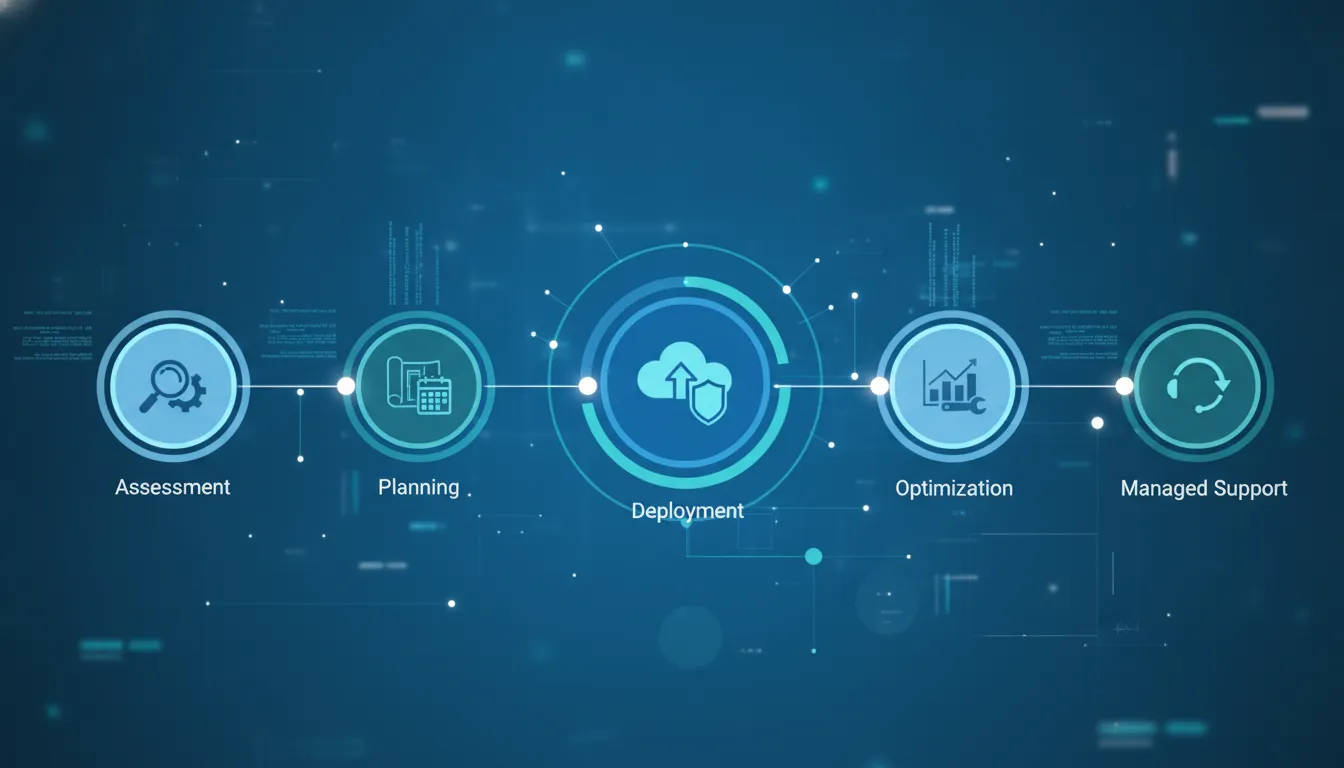
An ERP implementation roadmap can prevent an expensive technology project from becoming a disconnected series of decisions. It gives leaders one practical path from business assessment through platform selection, deployment, adoption, and ongoing support. More importantly, it keeps the program focused on measurable business outcomes instead of software features alone.
Discuss your ERP goals and roadmap with Streams Solutions.
A useful roadmap is not a fixed project calendar. It is a decision framework that explains what must happen, why it matters, who owns it, and how success will be measured. It also shows where the organization needs flexibility as requirements, risks, and priorities change.
This guide explains the major stages, governance decisions, platform considerations, and support planning that belong in an ERP roadmap. It also shows how Streams Solutions brings tri-platform experience across Oracle NetSuite, Microsoft Dynamics 365, and Salesforce to connected transformation programs.
What an ERP implementation roadmap must accomplish
An ERP implementation roadmap connects business outcomes to a sequenced plan for decisions, design, data, testing, adoption, launch, and support. It defines ownership, controls scope, and gives leaders clear checkpoints for managing risk.
A project plan lists tasks and dates. A roadmap explains the logic behind those tasks and dates. That distinction matters because ERP programs affect finance, operations, sales, customer service, reporting, and technology at the same time.
Connect business goals to system decisions
Every major system decision should trace back to an agreed business objective. A request for new workflow automation, for example, should solve a documented process issue. This discipline helps the team separate essential requirements from preferences.
The same principle applies to integrations, reports, and customizations. Each item adds cost, testing effort, and long-term maintenance. A roadmap helps leaders approve those investments with a clear understanding of their value and consequences.
Make ownership and decision rights visible
ERP programs stall when nobody knows who can approve scope, resolve a process conflict, or accept a risk. The roadmap should identify an executive sponsor, program lead, workstream owners, technical owners, and business process owners.
Decision rights should also be explicit. Some choices belong with process leaders, while others require steering committee approval. Defined escalation paths prevent routine disagreements from delaying the entire program.
Set checkpoints instead of relying on one launch date
A launch date is important, but it is not enough to manage the work. Strong roadmaps include stage gates for requirements, design, data readiness, testing, training, cutover, and post-launch stabilization.
Each gate should have clear acceptance criteria. The team should know what evidence is required before work advances. This approach exposes risk early, when leaders still have options to adjust scope, resources, or timing.
Phase 1: Assess the current state and define outcomes
The assessment phase documents current processes, systems, data, pain points, controls, and desired outcomes. Its purpose is to create an evidence-based case for change and a realistic scope for the ERP program.

The first phase should describe how the organization operates today. Teams need to understand current workflows, system dependencies, reporting gaps, manual work, data ownership, and recurring points of failure. Assumptions are not a reliable substitute for this discovery.
Document processes and pain points
Process discovery should include the people who perform the work, not only department leaders. Frontline users often know where data is reentered, approvals become stuck, spreadsheets fill system gaps, and policies are difficult to enforce.
Map the most important end-to-end processes across departments. Examples include lead to cash, procure to pay, record to report, inventory management, and service delivery. Cross-functional mapping reveals dependencies that department-level reviews can miss.
Not every pain point belongs in the first release. Rank issues by business impact, urgency, compliance risk, and implementation effort. That ranking will support later scope decisions and help protect the program from uncontrolled expansion.
Evaluate systems, integrations, and data
Create an inventory of applications, interfaces, reports, data stores, and manual transfers. Identify which systems will be replaced, retained, integrated, or retired. This inventory also clarifies where security and data ownership decisions are needed.
Data assessment should start early. Review completeness, accuracy, duplication, naming standards, retention rules, and ownership. The team should also decide how much historical data must move into the new platform.
Early data work reduces uncertainty during migration. It also helps leaders estimate the effort required for cleansing, mapping, validation, and reconciliation. Data readiness should be treated as a business responsibility supported by technical specialists.
Define measurable outcomes and boundaries
Define what the program will not address as well. Clear boundaries help teams make consistent choices when new requests appear. They also provide a fair basis for evaluating change requests later.
Phase 2: Select the platform, partner, and delivery model
Platform selection should compare business fit, integration needs, data model, operating requirements, scalability, governance, and total ownership demands. The delivery partner and implementation model should be evaluated with the same care.
Software selection is not a feature-counting exercise. The right platform must support target processes, integrate with the broader application landscape, and fit the organization’s ability to govern and maintain it.
Use business scenarios to compare platforms
Turn priority requirements into realistic business scenarios. Ask vendors and partners to demonstrate how each platform supports those scenarios. Scripted scenarios create a more useful comparison than broad product demonstrations.
Evaluation criteria should include financial management, operational workflows, reporting, controls, integrations, user experience, extensibility, and support needs. The weighting should reflect the outcomes defined during assessment.
Organizations considering Oracle NetSuite can use this NetSuite implementation guide to understand planning considerations. However, the final choice should follow business fit rather than platform familiarity alone.
Choose a delivery approach that matches risk
A phased deployment can limit disruption and create learning opportunities between releases. A broader launch can deliver connected processes sooner but requires greater readiness across teams. The roadmap should explain why the chosen approach fits the organization.
Leaders must also decide how internal teams and external specialists will share responsibility. Internal process owners provide essential business knowledge. An experienced partner contributes delivery structure, platform expertise, integration experience, and an outside view of risk.
Plan for the connected technology landscape
ERP rarely operates alone. Sales, service, commerce, payroll, analytics, and specialized operational systems may remain part of the landscape. Platform selection must account for those connections from the beginning.
Streams Solutions works across Oracle NetSuite, Microsoft Dynamics 365, and Salesforce. That tri-platform perspective helps organizations evaluate both the core ERP and the systems around it. It is especially useful when sales and finance data must remain connected.
Phases 3 and 4: Design processes, data, and integrations
Design converts approved outcomes into future-state processes, roles, controls, data structures, reports, and integrations. The goal is a coherent operating model that the organization can test, adopt, and support.
Design is where broad goals become specific operating choices. Teams decide how work will flow, which controls will apply, what information users need, and how connected systems will exchange data.
Design the future state before configuring it
Begin with future-state processes rather than copying every current practice. Some existing steps may reflect old system limitations instead of genuine business needs. The new design should simplify work while preserving essential controls and differentiators.
Process owners should approve designs and document unresolved decisions. They should also identify role changes, policy impacts, reporting needs, and training implications. These details will shape later testing and adoption work.
Customization needs careful governance. Configuration may meet many requirements with less maintenance. When customization is justified, document the business reason, owner, testing requirement, and long-term support impact.
Build a practical data migration plan
Use multiple migration cycles before launch. Early cycles test mappings and reveal quality issues. Later cycles improve timing, reconciliation, and confidence. Business owners should validate the meaning and completeness of migrated data.
Data governance should continue after launch. The roadmap should assign ownership for key records, quality monitoring, access rules, and change controls. Without that ownership, data quality can decline after the project team leaves.
Specify integrations by business purpose
Every integration should have a defined purpose, owner, frequency, source of truth, failure response, and monitoring plan. These details prevent interfaces from becoming invisible risks.
For leaders planning connected cloud systems, this cloud ERP guide provides additional context on integration and deployment considerations.
Phases 5 and 6: Build, test, and prepare people
Build and readiness work must progress together. Configuration, integrations, migration, testing, training, communications, and operational preparation all need evidence-based acceptance before launch.
Once designs are approved, delivery teams configure the platform, develop approved extensions, build integrations, and prepare migration routines. Business teams must remain involved because the system needs continuous validation against real operating needs.
Test complete business processes
Testing should move from individual components to complete end-to-end scenarios. A process may appear correct within one module but fail when data, approvals, integrations, or downstream reporting are included.
Plan unit testing, system integration testing, user acceptance testing, security testing, performance testing, and cutover rehearsals as appropriate. Define entry criteria, expected results, owners, defect priorities, and exit criteria for each stage.
User acceptance testing should use realistic scenarios and representative data. Business users need enough time to validate both normal work and exceptions. Open critical defects must be resolved or formally accepted before launch.
Treat adoption as a workstream
Change management should begin during assessment, not shortly before launch. Users need to understand why the program exists, how their work will change, and where they can raise concerns.
Managers need preparation too. They often reinforce new processes, monitor adoption, and address resistance after launch. The roadmap should define how leaders will support the change within their teams.
Use readiness criteria to protect the launch
A launch decision should rely on evidence rather than optimism. Readiness criteria may cover defect status, data reconciliation, user preparation, support staffing, security approval, cutover rehearsal, integrations, and business continuity plans.
A realistic timeline should include time for decisions and validation, not only technical tasks. This ERP implementation timeline resource explains factors that can influence planning.
Phase 7: Launch, stabilize, and improve
Launch is a controlled transition, not the end of the roadmap. The organization needs a rehearsed cutover, rapid issue response, adoption monitoring, performance reviews, and a governed improvement backlog.
Cutover moves the organization from the old operating environment to the new one. The plan should sequence final data activities, system changes, communications, validation, and fallback decisions. Every task needs an owner and a clear completion standard.
Manage cutover and early support
Rehearse the cutover before launch. A rehearsal tests timing, dependencies, communications, and decision points. It also helps teams identify tasks that need better instructions or additional resources.
After launch, a stabilization team should triage issues quickly and communicate status clearly. Priorities should reflect business impact. A visible escalation process helps prevent confusion during the first operating cycles.
Track adoption and process performance, not only system availability. Low usage, workarounds, delayed approvals, or recurring support questions can reveal where training or design improvements are needed.
Transition from project governance to operational governance
Project teams eventually step back, but governance must continue. Assign owners for platform administration, integrations, data, security, enhancements, releases, and vendor relationships.
Create a governed improvement backlog
Some valuable ideas will not belong in the first release. Capture them in a structured backlog with benefits, dependencies, risks, and estimated effort. Review the backlog on a regular schedule.
Governance and change control for the full roadmap
Effective ERP governance gives the right people authority to make timely decisions, control scope, manage risk, and verify outcomes. Change control protects the roadmap while allowing justified adjustments.
Governance should match the program’s size and complexity. At minimum, leaders need a steering forum, program management structure, workstream ownership, risk management process, and clear reporting cadence.
Establish a useful decision rhythm
Meetings should support decisions, not simply report activity. Teams should bring clear options, impacts, recommendations, and required approvals. A decision log preserves context and prevents the same questions from reopening without new evidence.
Program reporting should show progress against outcomes, stage gates, risks, budget, scope, and readiness. Status colors alone are not enough. Leaders need concise explanations of impact and next actions.
Control scope without blocking value
Use the StreamsWay to support collaboration
Streams Solutions uses the StreamsWay to center trust, collaboration, communication, client objectives, and value. Those principles support a roadmap because ERP decisions require consistent engagement across business and technology teams.
This approach also helps make tradeoffs visible. Instead of treating implementation as a closed technical exercise, Streams works with stakeholders to connect choices to operating goals and long-term support needs.
How platform choice changes the roadmap
The core roadmap stages remain consistent across platforms, but platform choice changes design options, integration patterns, governance needs, release planning, skills, and support responsibilities.
Organizations should not force every platform into an identical delivery model. Oracle NetSuite, Microsoft Dynamics 365, and Salesforce have different strengths, architecture choices, ecosystems, and operational considerations.
Oracle NetSuite
NetSuite programs often center on connected financial and operational processes within a cloud ERP. The roadmap should address account structure, roles, workflows, reporting, integrations, data migration, and release readiness.
Leaders should decide where standard platform processes fit and where changes create meaningful business value. That decision affects design effort, testing, adoption, and long-term maintenance.
Microsoft Dynamics 365
Dynamics 365 programs can span multiple business applications and connect closely with the broader Microsoft environment. The roadmap should define application boundaries, data ownership, security, integrations, analytics, and governance across the landscape.
The organization also needs a clear environment and release strategy. These decisions influence how teams build, test, deploy, and support changes over time.
Salesforce and connected ERP processes
Salesforce may lead customer-facing processes while an ERP manages financial and operational records. The roadmap must define ownership for accounts, products, orders, invoices, and other shared information.
Connected process design is essential. Sales and finance teams need agreement on definitions, handoffs, exception handling, and reporting. Streams Solutions brings Salesforce and ERP experience to help teams plan these cross-platform decisions.
Why tri-platform experience matters
A partner with tri-platform experience can evaluate the full operating landscape instead of treating each system as an isolated project. That perspective supports better decisions about platform fit, integration, data ownership, and phased transformation.
It also helps organizations plan beyond the first launch. As business needs evolve, the roadmap can account for future connections across ERP, CRM, analytics, commerce, and custom applications.
Why managed support belongs in the roadmap
Managed support belongs in the roadmap because ownership, monitoring, issue response, release planning, training, and improvement continue after launch. Planning support early creates a smoother transition from delivery to operations.
Support is often discussed late, after most design and staffing decisions are complete. That delay creates avoidable gaps. The implementation roadmap should define the future operating model while the system is still being designed.
Define the support model before launch
Clarify which requests internal teams will handle and which require external support. Define service routes, priorities, ownership, escalation, documentation, and response expectations. These choices influence training and knowledge transfer during implementation.
The model should cover more than incidents. It should also address administration, integration monitoring, data quality, security, platform releases, user support, reporting requests, and enhancement governance.
Connect support to business outcomes
Operational reviews should revisit the outcomes defined during assessment. Leaders need to know whether the platform is improving the intended processes and where users still face friction.
Managed support can help maintain continuity while internal teams focus on their core responsibilities. It can also provide specialist capacity for improvements that cross NetSuite, Dynamics 365, Salesforce, analytics, integrations, or custom applications.
Keep the roadmap active
The roadmap should become a living view of platform priorities after launch. Review it when business strategy changes, new requirements emerge, vendors release capabilities, or support trends reveal recurring issues.
A regular review cycle keeps investment connected to value. It also helps leaders sequence improvements based on readiness, dependencies, and expected impact.
ERP implementation roadmap checklist
A complete roadmap should cover outcomes, scope, governance, platform fit, process design, data, integrations, testing, adoption, cutover, support, and improvement. Each area needs an owner, decision path, and measurable acceptance criteria.
- Business case: Define the problems, outcomes, measures, and investment rationale.
- Scope: Identify included processes, business units, locations, systems, and exclusions.
- Governance: Assign sponsors, decision rights, workstream owners, escalation paths, and reporting cadence.
- Platform and partner: Evaluate business fit, delivery capability, integration needs, and support requirements.
- Future-state design: Approve processes, roles, controls, reports, and justified customizations.
- Data: Assign ownership and plan cleansing, mapping, migration, validation, and ongoing governance.
- Integrations: Define purpose, ownership, dependencies, monitoring, and failure handling.
- Testing: Plan end-to-end scenarios, acceptance criteria, defect management, and cutover rehearsals.
- Adoption: Prepare communications, role-based training, manager support, and adoption measures.
- Launch: Use readiness criteria, a rehearsed cutover plan, and a structured stabilization model.
- Operations: Establish support ownership, release planning, platform governance, and knowledge transfer.
- Improvement: Maintain a prioritized backlog and review the roadmap against business outcomes.
No roadmap removes every risk. A strong roadmap makes risk visible, gives leaders timely choices, and keeps the program aligned with business value. It also creates the structure needed to move from implementation into sustained improvement.
Streams Solutions combines technical advisory, tri-platform expertise, accelerators, implementation services, integration capabilities, and managed support. The StreamsWay keeps collaboration and client objectives central throughout the journey.
Ready to turn ERP priorities into a practical roadmap? Start a conversation with Streams Solutions and define the right next step.
Frequently asked questions
What is an ERP implementation roadmap?
An ERP implementation roadmap is a high-level plan that connects business outcomes to assessment, selection, design, data, testing, adoption, launch, and support. It also defines governance, ownership, decision points, and measures of success.
How long does an ERP implementation take?
The timeline depends on scope, process complexity, data readiness, integrations, customization, team capacity, platform choice, and deployment approach. A reliable estimate requires assessment and should include time for decisions, testing, training, and stabilization.
Who should own the ERP implementation roadmap?
An executive sponsor should remain accountable for business outcomes. A program lead manages delivery, while business process owners and technical owners make decisions within defined areas. A steering committee resolves cross-functional issues and major changes.
When should managed support planning begin?
Managed support planning should begin during design. Early planning clarifies ownership, documentation, monitoring, staffing, knowledge transfer, release management, and escalation needs before launch.